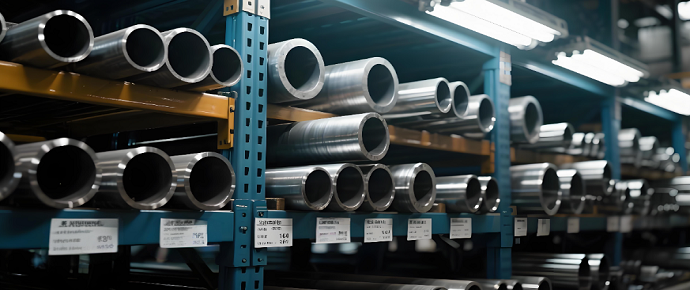
Alloy Steel Honed Tube: A Core Component in Industry and Engineering
In modern industry and engineering, Alloy Steel Honed Tube, as a high-precision, high-strength mechanical component, is used in virtually all hydraulic and pneumatic systems. Its outstanding performance and wide application have made it an indispensable key component in fields such as machinery manufacturing, construction engineering, energy equipment, marine engineering, and aerospace.
Definition and Basic Characteristics of Alloy Steel Honed Tube
What is Alloy Steel Honed Tube?
Alloy Steel Honed Tube is a high-precision tube made of alloy steel. Its core characteristic lies in its inner wall, which has been honed to achieve an extremely low roughness, ensuring a smooth, uniform, and defect-free surface. This unique processing method significantly reduces friction within the tube, improving system efficiency and extending the life of the equipment.
Manufacturing Process: The Transformation from Raw Materials to High-Precision Products
Material Selection: Select the appropriate alloy steel material based on the application, such as 4140, 4130, or 8620. These materials are widely used in the manufacture of high-precision tubing due to their high strength and excellent mechanical properties.
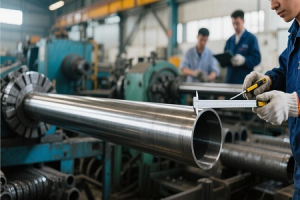
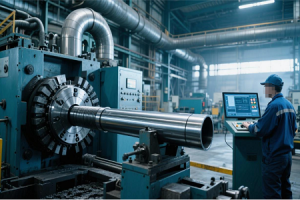
Cold Drawing or Hot Rolling: Cold drawing is a process that stretches the tubing to the target dimensions, improving its strength and surface finish. Hot Rolling: Hot rolling is more suitable for manufacturing large-diameter and thick-walled tubing, ensuring uniform wall thickness and excellent mechanical properties.
Honing: Honing is a core process in the manufacture of alloy steel honed tubes. Honing equipment precisely processes the inner wall of the tubing, removing minute roughness and achieving a mirror-like smoothness. This process directly impacts the efficiency and stability of hydraulic and pneumatic systems.
Heat Treatment: Heat treatment is a key step in enhancing the performance of alloy steel. Through the quenching and tempering process, the hardness, toughness, and fatigue resistance of the tube are enhanced, enabling it to maintain stable performance under complex operating conditions.
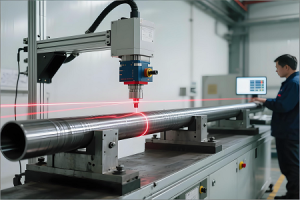
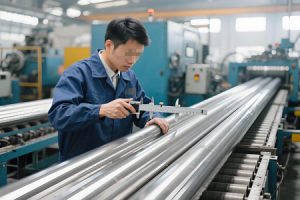
Quality Inspection: Each Alloy Steel Honed Tube undergoes rigorous testing, including dimensional inspection to ensure the accuracy of the inner diameter, outer diameter, and wall thickness; surface roughness inspection to verify that the inner wall meets the specified smoothness; and pressure testing to ensure that the tube can withstand its designed operating pressure.
Performance Characteristics and Advantages: Excellent Performance for Extreme Operating Conditions
Alloy steel honed tubes exhibit a variety of performance advantages, making them an irreplaceable key material in numerous applications.
They possess excellent mechanical properties. Typical alloy steel honed tubes have a tensile strength exceeding 620 MPa and a yield strength exceeding 440 MPa. This high strength-to-weight ratio enables lightweight equipment while maintaining structural integrity.
They exhibit excellent resistance to high temperatures and high pressures. For example, seamless steel pipes for high-pressure boilers are primarily used in high-temperature, high-pressure fluid transport headers and pipelines in power plants and nuclear power plants. Representative materials include 20G, 12Cr1MoVG, and 15CrMoG.
Third, the precision inner surface achieved through honing significantly reduces the coefficient of friction, improves sealing performance, reduces wear, and extends service life. The smooth inner surface also reduces resistance to fluid transport, improving system efficiency.
Honed alloy steel pipes also offer excellent corrosion resistance, adapting to a variety of harsh environments, including corrosive media such as acids, alkalis, and salts. This makes them widely used in fields such as chemical engineering and marine engineering.
Notably, alloy steel is 100% recyclable, aligning with national strategies for environmental protection, energy conservation, and resource conservation. This characteristic is becoming increasingly important as environmental protection requirements increase.
Application Analysis: An Indispensable Key Material in Multiple Industries
Honed alloy steel pipes have a wide range of applications, encompassing virtually all heavy industries and high-end manufacturing.
In hydraulic and pneumatic systems, alloy steel honed tubes are the primary material for hydraulic and pneumatic cylinders. Their precise inner surface ensures reliable piston sealing, reduces leakage, and improves system efficiency and reliability.
In the energy sector, alloy steel honed tubes are used in high-temperature, high-pressure environments such as power plant boilers, nuclear power plants, and the petrochemical industry. High-pressure boiler seamless steel tubes are specifically designed for high-temperature, high-pressure fluid transport headers and pipelines in power and nuclear power plant boilers.
Petroleum cracking seamless steel tubes are primarily used in boilers, heat exchangers, and their fluid transport pipelines in oil refineries. These applications place extremely high demands on the tube’s high-temperature, high-pressure, and corrosion-resistant properties.
In the aerospace and defense sectors, alloy steel honed tubes are used in fuel lines, hydraulic lines, and weapon systems. Aviation applications place stringent demands on material reliability, lightweighting, and high performance, and alloy steel honed tubes fully meet these requirements.
The automotive industry, particularly in the hydraulic systems of heavy-duty vehicles and construction machinery, makes extensive use of alloy steel honed tubes. With the automotive industry’s trend toward lightweighting and high performance, demand for alloy steel honing tubes continues to grow.
Other applications include chemical process equipment, geothermal and solar power generation systems, hydrogen refueling stations, CNG transportation, and LNG transportation. With the development of new energy technologies, the application areas of alloy steel honing tubes are continuously expanding.
Market Prospects and Development Trends: Global Growth and Technological Innovation Go Hand in Hand
The global alloy tube market is showing steady growth. According to QYResearch, global alloy tube market sales are expected to reach 155.42 billion yuan in 2031, with a compound annual growth rate (CAGR) of 5.1% (2025-2031). China is currently the world’s largest alloy tube market, accounting for over 35% of the market share, followed by Europe and North America, which together hold over 25% of the market share.
The global high-temperature alloy tube market reached 5.4 billion yuan in sales in 2023 and is expected to reach 6.7 billion yuan in 2030, with a compound annual growth rate (CAGR) of 3.1% (2024-2030). This growth is primarily driven by demand from sectors such as energy, aerospace, and defense.
From a technological perspective, alloy steel honed tubes are evolving toward higher precision, higher performance, and more environmentally friendly production processes. Innovative processes such as shortened production processes are reducing energy consumption and material waste during production, lowering production costs while improving product quality.
From a material R&D perspective, new alloys are continuously being developed and tested to meet the needs of various specific applications. Engineers and technicians are constantly collaborating with customers to address material challenges in specialized applications.
Alloy steel honed tubes are essential core components in modern industry and engineering. These high-strength, high-precision tubes play a vital role in construction machinery, energy equipment, marine engineering, and aerospace. By analyzing their properties, manufacturing processes, application scenarios, and future developments from multiple perspectives, we can gain a clearer understanding of the industrial value of alloy steel honed tubes. In the future, this material will undoubtedly continue to evolve with technological advancements, providing more efficient, reliable, and sustainable solutions for various industries.